
In brief
A surge of interest in humanoid robotics is sweeping across the globe, with many firms racing to innovate in this niche market. Among them is Unitree, a Chinese company showcasing its G1 humanoid robot, which has captured attention at international trade shows for its impressive dexterity and approachable design. As industries outline potential applications from workplaces to households, key challenges such as safety and artificial intelligence remain barriers to entry. Competing in the humanoid robot arena is especially fierce in Asia, where infrastructure and investments are significantly bolstered.
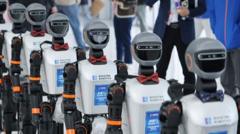
The opportunity for humanoid robots is vast, and the competition is heating up as innovation unfolds across borders. From Unitree’s charming G1 to Tesla’s ambitious Optimus project, the landscape is evolving amid considerations of safety, affordability, and usability.A bright spring morning in Hanover, Germany, brings together industry leaders at the Hannover Messe, showcasing developments in industrial technology, including a visit to see the G1 humanoid robot created by Unitree, a Chinese firm. Standing at about 4'3" (130cm), the G1 presents a more affordable and compact alternative to existing humanoid robots. With movement so fluid that videos of its dance routines and martial arts performances have gone viral, it draws attention and curiosity from onlookers. Controlled remotely by Unitree's sales manager, Pedro Zheng, the G1 requires programming by clients for its autonomous functions. Notably, it prompts charming interactions from passersby who engage with it on a human level, a feat many competing machines struggle to achieve—a testament to the uncanny familiarity of its humanoid shape. The booming interest in humanoid robots stems from the immense potential they hold for businesses. Manufacturing promises unprecedented benefits in employing a workforce that doesn't seek vacations or wage increases. Furthermore, the prospect of a domestic robot capable of mundane tasks such as laundry or dish-loading raises questions about its future integration into everyday life.However, significant hurdles still exist. While robots thrive in controlled environments like factories, creating humanoid machines adaptable to unpredictable settings like homes or restaurants remains a complex challenge. Strength is vital for functionality, yet it also raises safety concerns—the mere act of falling could yield hazardous consequences. Current limitations in artificial intelligence present another obstacle. A representative from Unitree candidly conveyed the status of AI technology, noting a lack of breakthroughs in logical reasoning, which is critical for completing complex tasks. For now, the G1 is primarily marketed to research institutions and tech companies engaged in further development.Industry-specific applications are currently drawing attention. High-profile projects include the Tesla Optimus, with CEO Elon Musk expecting to produce several thousand units this year, intended for roles in Tesla factories. Competitors such as BMW and Hyundai are similarly investing in humanoid robots for their manufacturing processes. The global landscape for developing humanoid robots is tracking an upward trajectory, with over 49 companies, including several categorized as humanoid, emerging in this sector. According to Thomas Andersson of research firm STIQ, many believe that Chinese firms will lead the field, owing to tightly knit supply chains and robust government support.The Asian market draws a significant share of funding—nearly 60% according to recent data from STIQ—providing companies like Unitree with clear advantages. Conversely, US and European firms face difficulties sourcing parts and manufacturing efficiently across vast distances.Bristol-based entrepreneur Bren Pierce shares that his latest robotics venture, Kinisi, launched its KR1 robot aimed at warehouse and factory applications—unlike previous humanoid designs. By reducing complexity and adopting mass-produced components, Kinisi hopes to keep expenditures manageable while providing ease of training for users.The KR1 is designed to train quickly with human guidance, reflecting a broader goal to create functional robots in everyday environments. However, Pierce acknowledges the uphill challenge that remains before humanoid robots penetrate domestic spheres. In conclusion, while the dream of developing versatile robots capable of assimilating into everyday life persists, industry experts predict that true integration could still be a decade or more away. The ongoing advancements in robotics present both exhilarating opportunities and complex challenges that will define the industry's future trajectory.

