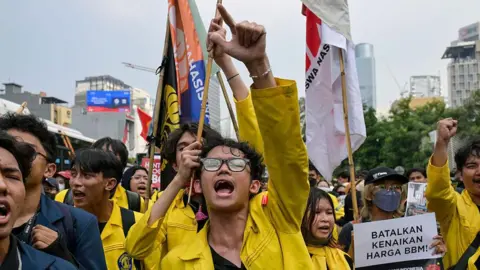
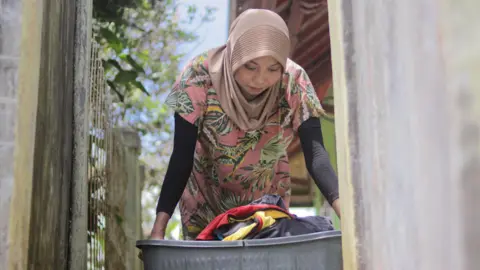
Indonesia's parliament has passed a law to protect the rights of domestic workers, more than 20 years after it was first introduced. The country is home to some 4.2 million domestic workers - of which almost 90% are women. They were previously not legally classified as workers. They will now be entitled to health insurance, rest days, and pensions. Placement agencies will also no longer be allowed to implement wage deductions, and it will be illegal to hire children under the age of 18 as domestic workers. Some wept upon hearing that the law was passed, with one worker saying it was the culmination of a '22-year struggle to gain protection'. The Domestic Workers Protection Law was first introduced in 2004 but repeatedly ran up against roadblocks. Discussions on the bill were stopped for years before being brought up again in parliament in 2020. Regulators will now have one year to draft detailed implementation policies. Despite their critical role in the economy, millions of Indonesia's domestic workers were unprotected under local labour laws. Many were employed informally without any legal contract. Some work long hours for little pay and some enter the profession from as young as 12. 'It feels like a dream,' Ajeng Astuti, one of the domestic workers told BBC Indonesian. 'This is our 22-year struggle as marginalised women to gain protection.' Jumiyem, a domestic worker from Yogyakarta, said, 'We've been longing for this [law], and now we can feel it'. Some rights groups hailed the law, but warned that more would still need to be done, adding 'the struggle is not over'. Lita Anggraini, of the Jala PRT rights group, told the news agency AFP that a public education campaign would be needed to teach employers about their responsibilities. The group reported more than 3,300 cases of violence against domestic workers from 2021-2024, including cases of physical and psychological abuse.
Indonesia Passes Landmark Law Recognizing Domestic Workers' Rights
Indonesia Passes Landmark Law Recognizing Domestic Workers' Rights
After a 22-year struggle, Indonesia has legally recognized the rights of domestic workers, primarily women, ensuring health insurance, rest days, and pensions.
Indonesia's parliament has finally passed the Domestic Workers Protection Law, recognizing the rights of approximately 4.2 million domestic workers, 90% of whom are women. This landmark legislation, which faced numerous obstacles since its inception in 2004, ensures that domestic workers are entitled to health insurance, rest days, and pensions, and prohibits the hiring of children under 18. While many celebrate this victory, rights groups emphasize that the struggle for full protection and awareness continues.