
In brief
Innovative X-ray and AI techniques have successfully provided a glimpse into a 2,000-year-old burnt scroll from Herculaneum, revealing promising fragments of ancient philosophy.
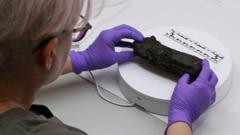
The article text:In a groundbreaking development, scientists have digitally "unwrapped" a badly charred scroll discovered in the ancient Roman town of Herculaneum, offering the first insight into its content in nearly 2,000 years. The scroll, which resembles a lump of charcoal due to the devastation wrought by the volcanic eruption of Mount Vesuvius in 79 AD, is too fragile to be physically opened. However, researchers utilized a combination of X-ray imaging and artificial intelligence to virtually reveal its contents, showing rows of text within the hardened layers.Further analysis is required to fully decipher the text, but the prospects are promising, as noted by Stephen Parsons, the project lead for the Vesuvius Challenge. This international initiative seeks to unlock the mysteries of the Herculaneum scrolls which were historically thought to be unreadable. Some letters from the scroll are already visible, hinting at its philosophical content.Hundreds of carbonized scrolls were unearthed in Herculaneum, a site that, like Pompeii, was buried beneath thick volcanic ash. Past attempts to physically open some scrolls resulted in them crumbling to dust, leaving the majority unopened for decades. The Bodleian Library at the University of Oxford houses several of these precious artifacts.Nicole Gilroy, the head of book conservation at the Bodleian, shared that there had often been doubts about whether any techniques would safely extract information from these scrolls. However, the promise of cutting-edge technology motivated the team to retrieve one of the scrolls from storage for further analysis.Once carefully transported to Diamond Light Source in Oxfordshire, the scroll was scanned using a synchrotron – a type of particle accelerator that produces powerful X-rays. This advanced imaging can probe the scroll's layers while avoiding damage, allowing for a high-resolution view of its contents.Adrian Mancuso, director of physical sciences at Diamond, explained that the scan captures images on a microscopic scale. The process involves isolating the layers within the scroll, which contains approximately 10 meters of papyrus, and analyzing them digitally.One of the significant challenges in the analysis is distinguishing between the ink and the carbonized papyrus since both materials share similar properties. By harnessing AI, researchers can detect minute signals indicating the presence of ink and digitally enhance the text visibility.Stephen Parsons expressed optimism about their ability to reveal nearly the entire scroll, confident that the project will transition from isolated words to substantial passages of text in the future. Last year, a different team within the Vesuvius Challenge managed to read about 5% of another Herculaneum scroll, which was centered on Greek Epicurean philosophy.The Bodleian scroll is believed to share a similar theme, leading the Vesuvius team to call for additional resources and innovation to deepen their research. Gilroy celebrates the work as a bridge to the past, emphasizing the human connection to those who collected and wrote these scrolls, stating the experience is "really precious."
