Global Opinion Shift: China Outgrows the US in Favorability, Pew Finds
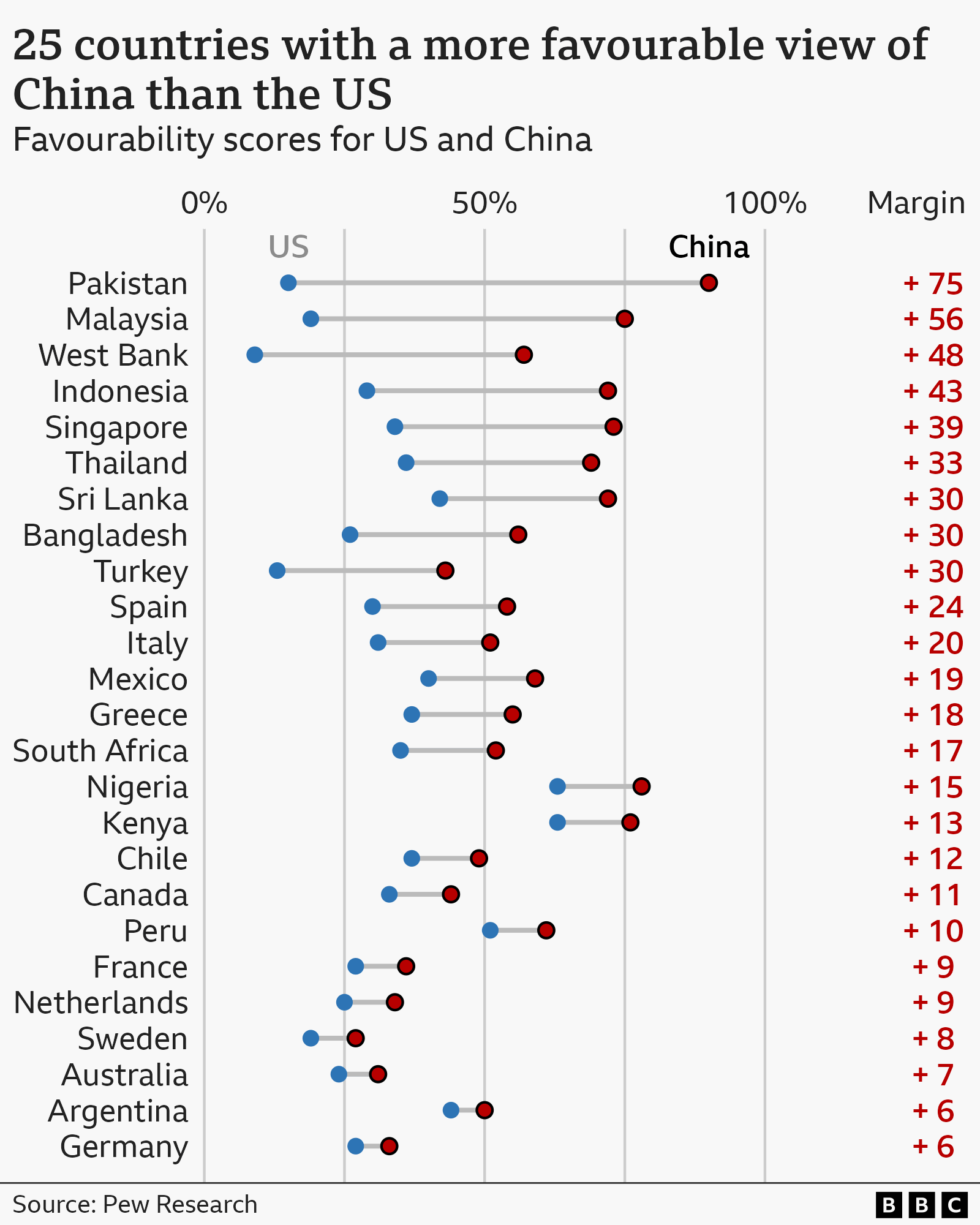
Pew Research Center’s most recent worldwide poll shows that China now enjoys a more favourable reputation than the United States in 25 out of 36 countries surveyed—a first in the agency’s history.
The survey asked 42,000 respondents across the globe, from Africa to Europe, the Middle East and Asia, whether they felt they had a very favourable, somewhat favourable, somewhat unfavourable or very unfavourable view of each superpower. In 25 nations, more people said they viewed China positively than the US.
Even as both leaders receive low confidence ratings, respondents gave higher approval to Chinese President Xi Jinping than to former US president Donald Trump. Xi scored 22% higher on confidence while Trump sits at a marginal 6% below a neutral stance.
On key policy differences, people still perceive the US as maintaining broader respect for personal freedoms, but the proportion of respondents who see the US as interfering heavily in other countries’ affairs has risen. A median of 75% of middle‑income respondents said the US interferes a great deal or a fair amount, compared with 45% who perceive a similar stance from China.
The most striking swings came from Spain, Indonesia, Italy, Greece and Canada, where favourability for China outpaced the United States by large margins. In contrast, only six polls—Poland, the Philippines, South Korea, India, Japan and Israel—still show a lead for the US, all of them strong allies.
“The results point to growing confidence in China’s role on the world stage and increasing scepticism toward US policies, especially in the post‑Trump era—where instability felt sharply acutely—” said co‑author Jonathan Schulman.
Experts attribute the trend to the U.S.’s perceived volatility: use of force, economic disruptions and a shift in foreign policy that has rattled global opinion. Meanwhile, Beijing’s intensified public‑relations push has earned a more predictable image among respondents, especially in developing economies.
The Pew data also sheds light on regional nuances: in the Asia‑Pacific, 90% of Pakistanis expressed a positive view of China, whereas only 11% of Japanese respondents did. In the OECD, the census reveals a rising disparity with richer nations showing more negative opinions of China, an exception being Singapore—a highly affluent nation that nevertheless shows significant positive sentiment.
This survey signals a pivotal moment for international politics, suggesting that China’s strategic outreach and the US’s unpredictable posture may reshape how nations view leadership on the world stage. The findings will be closely watched by policy makers, diplomats and analysts eager to gauge the next wave of geopolitical alliances.