
In brief
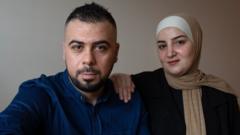
Douna Haj Ahmed, a Syrian refugee in London, learns for the first time about her husband Abdullah Al Nofal's traumatic experiences in Al-Khatib prison, known for its brutal treatment of detainees. As Abdullah recounts his time in solitary confinement and the chilling atmosphere of the facility, the couple highlights the importance of sharing their story to shed light on the horrors inflicted during Syria's civil war.
It was a poignant moment in early December when Douna Haj Ahmed, a Syrian refugee living in London, stumbled upon the shocking details of her husband’s detention in the infamous Al-Khatib prison. This facility, often referred to as "Hell on Earth," had seen countless prisoners endure unimaginable suffering under the brutal regime of Bashar al-Assad. The revelation came as Douna watched news reports of prisoners escaping the regime's grasp following the ousting of Assad. Her husband, Abdullah Al Nofal, sitting beside her, pointed to the screen, eyes filled with tears, and quietly said, “This is where I was arrested, this is the place.”For nearly a decade, Douna had been aware of her husband’s harrowing experiences during Syria’s prolonged civil war, but this moment marked the first time Abdullah openly shared the complete horror of his reality. “Abdullah doesn’t like to share things emotionally; he wants to appear strong,” Douna reflected. “But that day, I saw him weak. I saw him crying. This was a turning point for us.” She emphasized the importance of their story, stating, “Now we want people to hear what Syrians went through.”In July 2013, while working as a store keeper for the International Committee of the Red Cross in Damascus, Abdullah’s life changed irrevocably at a security checkpoint. Despite having participated in peaceful anti-regime protests in 2011, he had distanced himself from the escalating violence. At the checkpoint, he was singled out, handcuffed, blindfolded, and taken to a military location where his nightmare truly began. “I was put in solitary confinement for three days and beaten,” Abdullah recalls, the darkness and isolation remaining etched in his memory.His journey led him to Al-Khatib, a notorious detention center. Estimates suggest that approximately 60,000 individuals lost their lives due to torture in prisons operated by the Assad regime during the civil war. One notorious perpetrator, Anwar Raslan, was recently convicted by a German court for crimes against humanity linked to his time overseeing detainee torture at Al-Khatib.“Every minute it feels like you’re dying,” Abdullah described his experience of hearing the screams of suffering inmates. “If you didn’t get tortured yourself, every time they would take someone away for interrogation, you would know they wouldn’t return unscathed.” Abdullah vividly recalls the grim reality: detainees often returned covered in blood or in excruciating pain from the brutal beatings and torture they endured.After nearly a month of interrogation and torment, Abdullah managed to convince his captors of a false narrative to secure his release. Feeling fortunate to escape alive, he eventually fled Syria, obtaining scholarships in Geneva and the United States, before settling with Douna in London. Now, free from the fear that once silenced him, Abdullah finally opened up about his traumatic past. "We feel like we can share our story," he stated, emphasizing their newfound freedom to speak out. Douna, a passionate human rights activist, expressed her emotional response to learning about her husband's experiences for the first time. “Every time I think I’ve heard the worst, I learn there’s even more horror. We are privileged; many others never got to tell their stories,” she lamented.The couple remains committed to sharing the truth about the tragic realities of life in Syria, shedding light on the dark history of injustice and suffering that continues to affect countless individuals and families to this day.

