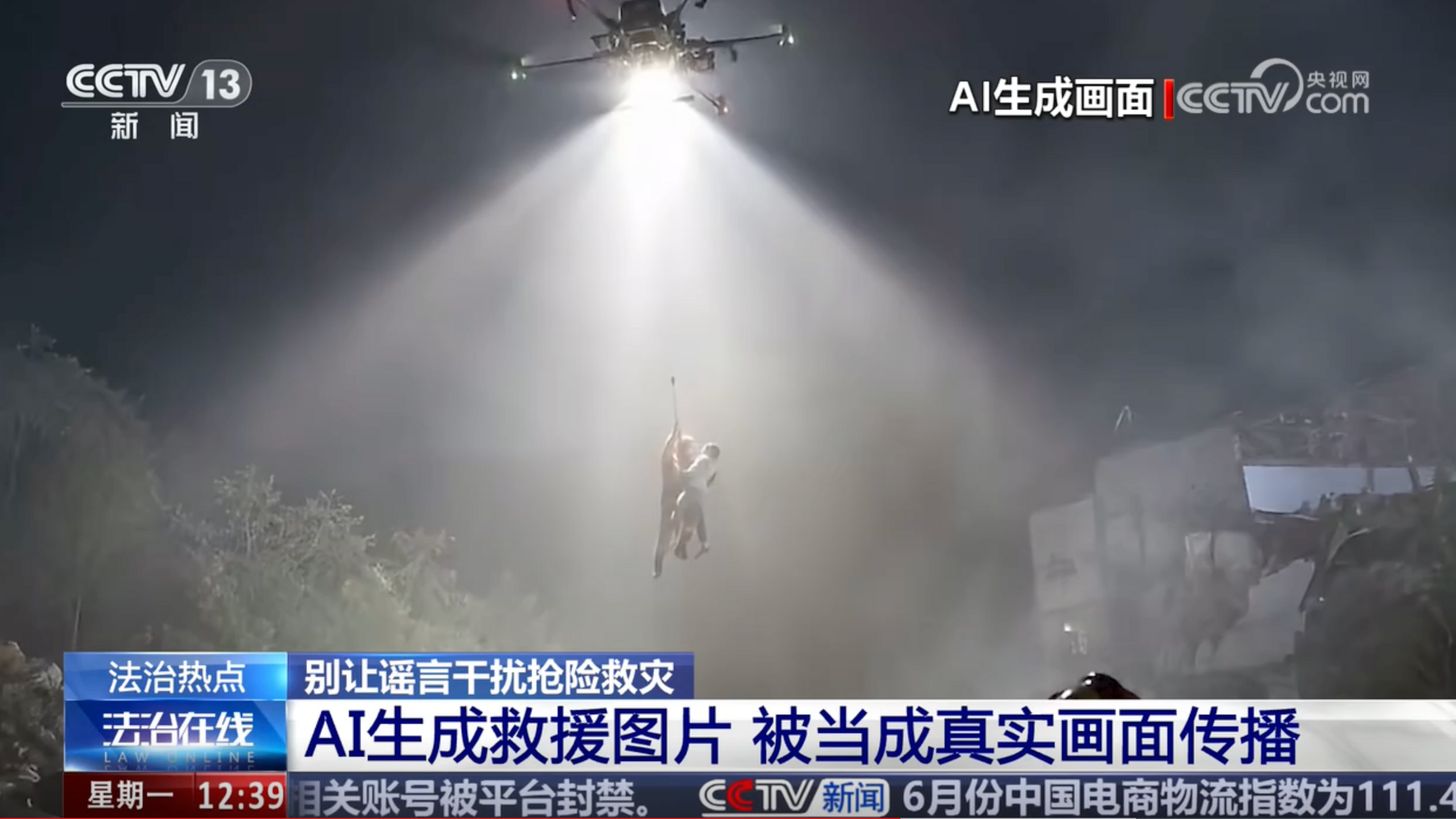
The Typhoon Noul that hit China on the weekend has turned a natural disaster into a complex crisis of both logistics and information. As rescue teams flood‑plunged homes and shoring up dam walls, a new threat looms: a flood of fake videos created with Artificial Intelligence (AI) that can spread misinformation faster than the rain.
In the chaos, social media was flooded with clips of dead bodies in floodwater, false claims of extensive damage in untouched areas, and staged scenes where rescuers supposedly prioritized pigs over people. One viral clip showed what looked like crocodiles being released into a river, a scene that never happened and caused panic buying of emergency supplies in nearby towns.
“Content creators purposely exaggerate disaster news to gain views,” said Huang Zhihua, a deputy chief of Zhejiang Police. “These videos are deliberately fabricated to attract attention.”
The Chinese government’s crackdown has already hit dozens of offenders, with arrests ranging from detention to fines, and a national task force now monitoring short‑video platforms for false claims. Police chief Gao Kai of the Ningbo Public Security Bureau urged people to verify any disaster information from trustworthy sources before acting.
Experts argue that AI lowers the barrier to creating credible yet entirely fake content. Professor Chen Bin of the Central Party School warned that AI “can produce realistic but fabricated content on a large scale. Meanwhile, Professor Gao Fuping from East China University of Political Science and Law noted that the motives for spreading such content span from pure entertainment to deliberate social unrest.
The speed at which deepfakes can be generated outpaces detection, according to Professor Xu Xiaoke of Beijing Normal University. He stresses that verifying geographic locations with timestamps and source traceability is essential, but that the technology gap remains a major concern.
China’s push for AI domination has seen billions invested in tech firms—over 6,000 companies, according to Xinhua—yet the government stresses the need for an official “trusted information infrastructure” to counter misinformation during emergencies.
Beyond floods, scholars predict that AI‑generated misinformation could spread rapidly through elections, public health crises, armed conflicts and natural disasters. Professor Xu argues that governments and platforms must act proactively, rather than reacting after a viral clip spreads.
While China’s Cyberspace Administration’s recent nationwide crackdown focuses on fabricated data and staged scenes, legal experts warn that platform liability will be increasingly scrutinised. The United States‑based lawyer Peter Pang stresses that the platforms that host misleading content will face accountability for the resulting harm.
In an era where AI can produce convincing videos from a simple prompt, the line between legitimate information and manufactured panic blurs. The on‑point news team will continue to monitor the evolving battle between emergency management and digital deception in China, keeping audiences informed with live expert analysis and investigative depth.