In brief
Doha has unveiled Lawh Wa Qalam, the world's first museum dedicated to renowned Indian artist MF Husain. Spanning 3,000 square meters, the museum features more than 150 works, including paintings and sculptures. It aims to provide visitors with an intimate experience of Husain's artistic journey and his deep connection with Arab civilization. The design reflects Husain's philosophies, creating an interactive space that invites exploration and discovery.
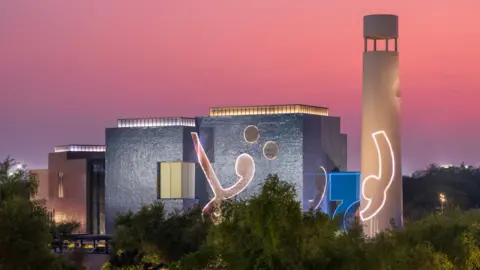
At the edge of Doha, a new grey-blue building rises like a drawing on its skyline, its shimmering tiles shifting with the sun and casting geometric shadows. The building seems to be leaning forward, as if eager to tell a story. In a video clip of Lawh Wa Qalam, the world's first museum dedicated to MF Husain, we see glimpses of the extraordinary work of the late legendary Indian artist, whose prolific paintings and turbulent personal history have fascinated the world.The museum honours the legacy of the artist who spent his last years in Qatar and was granted citizenship in 2010. Spanning over some 3,000 sq m, it opened to visitors last week and is part of the expansive campus of Qatar Foundation's Education City, an educational and research hub. Inside, more than 150 works and objects - including paintings, sculptures, films, tapestries, and photos - map the astonishing breadth of Husain's career, offering visitors a rare window into the artist's late-life reflections and inspirations.Husain always wanted his museum to feel like home, says Noof Mohammed, the curator. We want visitors to experience the world as he did, in an intimate, playful, and reflective manner.Few artists have travelled as widely or imaginatively as Husain. His horses - muscular and dynamic - remain some of the most prized and instantly recognisable paintings in contemporary art, sold for millions of dollars. An artist who was often described as having a nomadic and bohemian disposition, he dabbled seamlessly in Cubist-inspired modernism and traditional Indian themes, creating bold and vibrant canvases with scenes from history and mythology. His signature style earned him the moniker of the Picasso of India. After a tumultuous few years, it was in Qatar, away from the cultural battles at home, that he entered a period of deep contemplation and artistic renewal. He was deeply engaged here, charmed and inspired by Arab civilization and culture, Yousef Ahmad, a Qatar-based artist who knew Husain during his final years, told the BBC. The museum features a multimedia project called Seeroo fi al ardh (Walk In The Land), which occupied Husain's final years and was envisioned as a narrative of civilization told through movement, sound, and mechanical choreography. The building itself is inspired by a 2008 sketch Husain made.Martand Khosla, the Indian architect who designed the museum structure, emphasizes the challenge of translating Husain's philosophical intent into a functional space, leading to a labyrinthine layout that invites exploration. We hope the museum sparks discovery the same way Husain's murals do - each visit can reveal a completely different experience or discovery. Each gallery opens with a Husain quote, inviting visitors into his thoughts, and the exhibition includes his beloved horses prominently.The museum's collection features 36 works commissioned by Husain for a project on Arab history and culture commissioned by Sheikh Moza bint Nasser. His works reflect a rich connection with both Indian and Arab cultural narratives. With many of Husain’s paintings revealing a masterful blend of tradition and modernity, the museum serves not only as a tribute but as a re-evaluation of his work in a contemporary light.