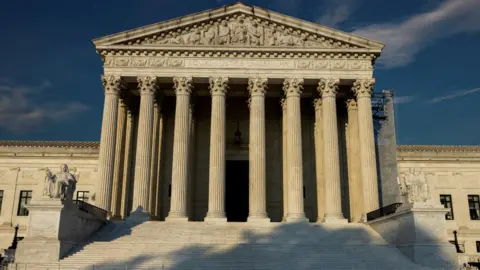
The US town of Bristol, population around 44,000, is a divided community. Split between Virginia and Tennessee, the state line runs literally down main street. While both sides have much in common, there is one major difference - abortion is illegal in Tennessee. This has been the case since the 2022 Supreme Court ruling which gave individual states, rather than the federal government, the power to legislate abortion, triggering 12 states to pass near-total bans.
So the city's only abortion clinic, Bristol Women's Health, moved less than a mile down the road to continue practising legally in Virginia. But just because abortion is legal in Virginia it doesn't mean the battle for abortion access is over.
It's like whack-a-mole, said Barbara Schwartz, the co-founder of SLAAP, the State Line Abortion Access Partnership. They assist people travelling into Virginia to get an abortion at Bristol Women's Health Clinic. As soon as one approach doesn't work, the anti-abortion crowd pops up in Bristol and tries another.
On December 22, Bristol's Circuit Court will hear the clinic's case against an eviction notice served by their landlords, brothers Chase and Chadwick King in April 2024. Lawyers for the clinic argue it has the right to renew its lease for a total of six more years. But if the judge rules in favour of the building's owners, the clinic will be forced to find a new home.
This is not the landlords' first attempt to remove the clinic from their property. The brothers claimed that the clinic fraudulently concealed that they perform abortions, to which they maintain to be adamantly opposed. The case was dismissed in September last year, with Judge Sage Johnson ruling: If [the landlords] had conducted a simple internet search on their tenants, as any reasonably prudent landlord likely would, they would have discovered that the clinic did, in fact, provide abortion services as is plainly stated on their website.
Clinic owner Diana Derzis, who declined to comment on the hearing, stated that she hopes to keep the clinic in the city, even if they are evicted. However, she noted there are few other suitable facilities in Bristol, Virginia.
The clinic leaving Bristol would be a blow to abortion access, according to Barbara Schwartz. Since Roe v Wade was overturned, states where abortions are legal have become destinations for out-of-state abortion seekers, with 155,000 people crossing state lines last year, according to the Guttmacher Institute (GI). Over 9,200 people travelled to Virginia alone to have the procedure performed last year.
Bristol's position means the clinic is the closest place by several hours to get a safe and legal abortion for millions of southerners, Schwartz added.
Victoria Cobb, the director of anti-abortion lobbyist the Family Foundation, also notes that Bristol's location places it at the epicentre of the debate. She has launched efforts to restrict abortion access in Bristol by leveraging local bylaws. The strategy aims at fighting localized battles where traditional legislative routes may fail.
The Family Foundation argues in the past that the existence of the clinic goes against zoning regulations, claiming that it endangers life. Their ordinance sought to prohibit new clinics and block expansions of existing abortion facilities. Similar rules have been used in other parts of the US to restrict abortion but are criticized as largely ineffective virtue signaling.
As the debate in Bristol evolves, it highlights the deep divisions within the community and the broader implications of state-level abortion policies in America.
So the city's only abortion clinic, Bristol Women's Health, moved less than a mile down the road to continue practising legally in Virginia. But just because abortion is legal in Virginia it doesn't mean the battle for abortion access is over.
It's like whack-a-mole, said Barbara Schwartz, the co-founder of SLAAP, the State Line Abortion Access Partnership. They assist people travelling into Virginia to get an abortion at Bristol Women's Health Clinic. As soon as one approach doesn't work, the anti-abortion crowd pops up in Bristol and tries another.
On December 22, Bristol's Circuit Court will hear the clinic's case against an eviction notice served by their landlords, brothers Chase and Chadwick King in April 2024. Lawyers for the clinic argue it has the right to renew its lease for a total of six more years. But if the judge rules in favour of the building's owners, the clinic will be forced to find a new home.
This is not the landlords' first attempt to remove the clinic from their property. The brothers claimed that the clinic fraudulently concealed that they perform abortions, to which they maintain to be adamantly opposed. The case was dismissed in September last year, with Judge Sage Johnson ruling: If [the landlords] had conducted a simple internet search on their tenants, as any reasonably prudent landlord likely would, they would have discovered that the clinic did, in fact, provide abortion services as is plainly stated on their website.
Clinic owner Diana Derzis, who declined to comment on the hearing, stated that she hopes to keep the clinic in the city, even if they are evicted. However, she noted there are few other suitable facilities in Bristol, Virginia.
The clinic leaving Bristol would be a blow to abortion access, according to Barbara Schwartz. Since Roe v Wade was overturned, states where abortions are legal have become destinations for out-of-state abortion seekers, with 155,000 people crossing state lines last year, according to the Guttmacher Institute (GI). Over 9,200 people travelled to Virginia alone to have the procedure performed last year.
Bristol's position means the clinic is the closest place by several hours to get a safe and legal abortion for millions of southerners, Schwartz added.
Victoria Cobb, the director of anti-abortion lobbyist the Family Foundation, also notes that Bristol's location places it at the epicentre of the debate. She has launched efforts to restrict abortion access in Bristol by leveraging local bylaws. The strategy aims at fighting localized battles where traditional legislative routes may fail.
The Family Foundation argues in the past that the existence of the clinic goes against zoning regulations, claiming that it endangers life. Their ordinance sought to prohibit new clinics and block expansions of existing abortion facilities. Similar rules have been used in other parts of the US to restrict abortion but are criticized as largely ineffective virtue signaling.
As the debate in Bristol evolves, it highlights the deep divisions within the community and the broader implications of state-level abortion policies in America.