
In brief
Several European companies developing electric vertical take-off and landing (eVTOL) aircraft are grappling with funding shortages, leading to delays and insolvencies. While some projects face a bleak outlook, others like Vertical Aerospace continue to seek financial partnerships amidst uncertainties in the rapidly evolving aerial taxi industry.
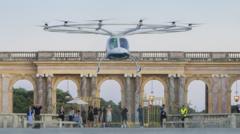
Europe's ambitions for electric flying taxis face significant obstacles as several pioneering companies confront severe funding shortages. The spotlight had been on Germany’s Volocopter, which aimed to make its flying taxi, the VoloCity, operational during this year's Paris Olympics. However, instead of launching a commercial service, they only managed to conduct demonstration flights. Beneath this setback lies a more pressing challenge: Volocopter's battle to secure fresh investments for survival. Initial talks for a €100 million loan from the government faltered in April, fueling speculation that a deal with China's Geely, which seeks to acquire an 85% stake for $95 million, may shift future manufacturing capabilities to China.Volocopter is not alone in this challenge; it is among dozens of firms competing in the burgeoning eVTOL sector, which promises the efficiencies of helicopter transport without the hefty costs, noise, or emissions. Yet regulatory approval, alongside manufacturing logistics, has proved daunting, causing some investors to withdraw.Another notable casualty is Lilium, a German firm that had embarked on an ambitious design employing a fleet of 30 tiltable electric jets. Although Lilium secured numerous orders totaling 780 jets globally and had anticipated testing the first full-size aircraft in 2025, funding issues led it to insolvency proceedings in November. Attempting to arrange a €100 million loan with Germany's KfW proved unsuccessful once government guarantees were lacking. The company remains in operation, seeking buyers or new investors to reinvigorate its ambitious projects.The UK’s Vertical Aerospace, established in 2016 by Stephen Fitzpatrick, has made noticeable progress with its VX4 eVTOL design. However, the company too has grappled with challenges, including a serious crash in 2022 and losing engineering partner Rolls Royce. Despite recent setbacks, Vertical Aerospace secured a rescue deal with Mudrick Capital, which will convert $130 million in loans to equity, affording Mudrick a 70% stake in the company but providing necessary liquidity to continue operations.In contrast, there is an optimistic outlook for Airbus's eVTOL project, the CityAirbus NextGen. Aerospace expert Bjorn Fehrm posits that Airbus's project has the financial backing and expertise needed to produce its four-seater aircraft. This might signify a more stable path forward compared to startups struggling for survival.Meanwhile, established firms in the US, like Joby and Archer, are perceived as more financially stable, raising questions about the long-term viability of European contenders in the eVTOL market. As initial operations likely focus on shuttle routes between urban centers and airports, challenges in securing profitable operations loom large, particularly regarding costs tied to pilots and battery replacements.The road ahead is uncertain for these pioneering electric aircraft companies, leading industry analysts to ponder the motivation behind these investments amid a landscape of skepticism. The allure of replicating the success of ventures like Tesla drives continued interest, albeit with increasing caution on the part of investors.
