
In brief
A survey by the Carnegie Endowment and YouGov reveals shifting political attitudes among Indian Americans amid ongoing tensions between India and the US. With over five million Indian-origin residents in the United States, sentiment has been scrutinized in light of two crucial elections, an attempted assassination indictment, and perceptions of foreign policy direction.
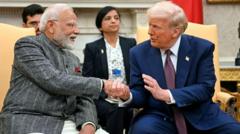
The 2024 Indian-American Survey examined the complexities of political opinions among this demographic, revealing that while a significant proportion remains optimistic about India's trajectory under Prime Minister Narendra Modi, there exists a deep concern regarding the potential implications for US-India relations under a second term for Donald Trump.The survey, comprising responses from 1,206 Indian-American adults, showcases partisan divisions on foreign policy perspectives. Notably, Indian Americans exhibited a more favorable view of President Joe Biden's handling of US-India ties when juxtaposed against Trump's first term. A hypothetical administration led by Kamala Harris was also perceived as more beneficial for bilateral relations compared to a second Trump term.This contrast is striking when viewed through the lens of party affiliation. A notable 66% of Indian-American Republicans favored Trump regarding US-India relations, while only 8% of Democrats reciprocated that sentiment. Conversely, around half of Indian-American Democrats preferred Biden over Trump, leading to a concluded lean towards the Democratic Party overall.Events such as the February meeting between Trump and Modi at the White House, during which both leaders commended each other's leadership while addressing trade concerns, epitomize the precarious balance between camaraderie and contention in bilateral relations.Complicating perspectives further are recent allegations involving a murder-for-hire plot linked to the Indian government—only half of survey respondents were aware of these serious accusations. The indictment of a former Indian intelligence operative for attempting to assassinate a pro-Khalistan advocate in the US marks a challenging moment for diplomatic relations. Responses showed that a narrow majority found India unjustified if roles were reversed, highlighting how deeply political sentiment intertwines with broader community narratives.The survey also delved into broader geopolitical issues, revealing partisan divisions on topics like the Israeli-Palestinian conflict, with Democrats displaying greater sympathy for Palestine compared to Republicans.While nearly half of Indian Americans believe India is progressing positively—a notable increase from four years prior—a significant gap in awareness regarding significant geopolitical issues indicates a selective engagement with news related to both Indian and US politics. This raises questions about how political identities are molded and perceived across national lines for Indian Americans.Conclusively, the survey reflects a multifaceted portrait of the Indian American community, grounded in a complex interplay of selective engagement with socio-political developments, historic ties to India, and an evolving relationship with the US political landscape.

