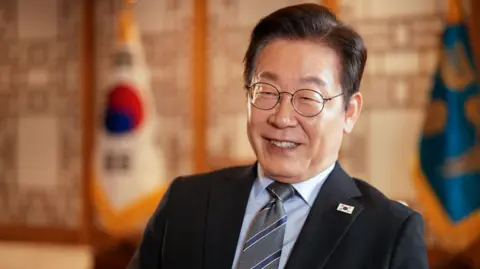
In a groundbreaking interview with the BBC, South Korean President Lee Jae Myung articulated his readiness to accept a deal that would involve North Korea freezing its nuclear weapons production as a pragmatic alternative to complete denuclearization.
During the interview, President Lee pointed out that North Korea is reportedly adding 15 to 20 nuclear weapons each year, underscoring the pressing need for a response to this escalating threat. He deemed a nuclear freeze as a feasible strategy, earmarked as an 'interim emergency measure' to curb North Korea's aggressive advancements.
So long as we do not give up on the long-term goal of denuclearization, I believe there are clear benefits to having North Korea stop its nuclear and missile development, he stated. His comments reflect a shift from previous administrations and an attempt to establish more balanced and constructive relations with the North.
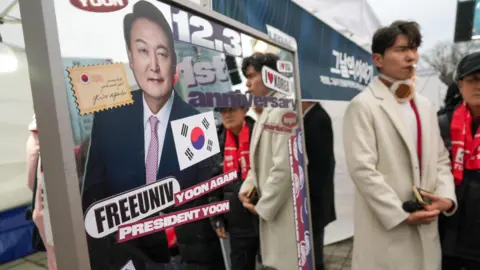
Lee, who took office in June, is keen on reducing tensions that escalated under his predecessor, Yoon Suk Yeol. Contrary to Yoon's assertive stance, Lee advocates for diplomatic engagement, including the resumption of talks between Trump and Kim, which ceased in 2019 after U.S. demands for full denuclearization were rebuffed.
President Lee expressed confidence that a renewed dialogue could emerge, given the previous camaraderie exhibited between Trump and Kim, which he believes could lead to beneficial outcomes for the Korean peninsula and enhance global peace.
In a broader geopolitical context, Lee is navigating complex relationships involving the U.S., China, and Russia. He commented on the recent warming ties between these nations and North Korea, which complicates South Korea's security landscape. While advocating for closer ties with the U.S. and Japan, he acknowledges the challenging dynamics at play.
As South Korea presides over the UN Security Council, President Lee chose to focus on constructive measures rather than critique the Council's effectiveness, even as some of its resolutions regarding North Korea have been blocked by China and Russia. He expressed a sense of responsibility to foster an environment of trust and dialogue, a significant departure from before.
In conclusion, while President Lee's approach to North Korea remains cautious and measured, it reflects a pragmatic shift in South Korea's foreign policy that aims to address immediate security concerns while pursuing longer-term goals of peace and stability.