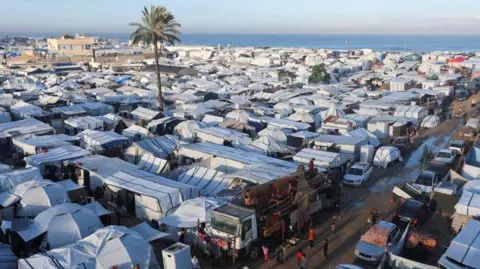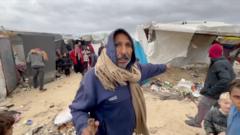
The beaches of Gaza, once a place for leisurely outings, have transformed into makeshift living areas for tens of thousands of Palestinians displaced by ongoing conflict. With winter now upon them, these residents face the compounding threat of harsh weather, devastating the flimsy shelters they call home. Mohammed al-Halabi, a resident from Deir al-Balah, describes the dire situation: "Nothing is left in the tent: not mattresses, bedding, bread, everything was taken. The sea took it."
The United Nations reports that nearly all of Gaza's 2.3 million residents are displaced, with nine out of ten people seeking refuge in tents. As temperatures plummet, many are succumbing to illness due to exposure. Shaima Issa from Khan Younis shares heartbreaking accounts of her children's suffering: "My daughter has a fever because of the cold. We’re essentially living on the streets, surrounded by strips of fabric. Everyone here is sick and coughing."
Salwa Abu Nimer, a neighbor, adds to the grim narrative of survival: "When it rains on us, we’re drenched... The heavy rain floods us, and we don’t have a waterproof cover." With no food, clean water, or adequate shelter, residents express their despair: “What is this life I’m living? I go to the ends of the earth just to feed my children.”
Though the worst conditions are reported in northern Gaza, the UN has described the entire situation as "catastrophic," with shortages of medicines, food, and shelter. Long lines form for meager charity handouts, with distressed locals pushing through crowds at bakeries in desperate searches for bread. Hanan al-Shamali, who suffers from chronic health issues, explains the perilous struggle. “I can’t push through crowds of people; I’m afraid I’ll suffocate and die,” she laments.
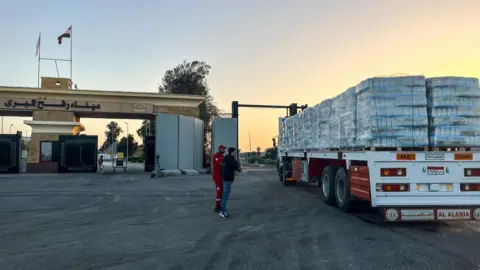
At the Kerem Shalom crossing, aid has reached critically low levels despite trucks preparing shipments. Israeli spokespersons attribute distribution challenges to international aid organizations, but humanitarian workers counter that lawlessness within Gaza has allowed armed gangs to hijack incoming supplies. This has forced the United Nations Relief and Works Agency (Unrwa) to temporarily halt deliveries through this critical channel.
Antoine Renard, of the UN’s World Food Programme, paints a harrowing picture of daily life for Palestinians. "The levels of hunger, devastation, and destruction we are seeing now in Gaza is worse than ever before," he asserts, warning that the situation is becoming increasingly untenable.
Amidst the bitter cold and ongoing conflict, Gazans face an uncertain future, with the risk of further suffering looming as winter deepens.
The United Nations reports that nearly all of Gaza's 2.3 million residents are displaced, with nine out of ten people seeking refuge in tents. As temperatures plummet, many are succumbing to illness due to exposure. Shaima Issa from Khan Younis shares heartbreaking accounts of her children's suffering: "My daughter has a fever because of the cold. We’re essentially living on the streets, surrounded by strips of fabric. Everyone here is sick and coughing."
Salwa Abu Nimer, a neighbor, adds to the grim narrative of survival: "When it rains on us, we’re drenched... The heavy rain floods us, and we don’t have a waterproof cover." With no food, clean water, or adequate shelter, residents express their despair: “What is this life I’m living? I go to the ends of the earth just to feed my children.”
Though the worst conditions are reported in northern Gaza, the UN has described the entire situation as "catastrophic," with shortages of medicines, food, and shelter. Long lines form for meager charity handouts, with distressed locals pushing through crowds at bakeries in desperate searches for bread. Hanan al-Shamali, who suffers from chronic health issues, explains the perilous struggle. “I can’t push through crowds of people; I’m afraid I’ll suffocate and die,” she laments.
At the Kerem Shalom crossing, aid has reached critically low levels despite trucks preparing shipments. Israeli spokespersons attribute distribution challenges to international aid organizations, but humanitarian workers counter that lawlessness within Gaza has allowed armed gangs to hijack incoming supplies. This has forced the United Nations Relief and Works Agency (Unrwa) to temporarily halt deliveries through this critical channel.
Antoine Renard, of the UN’s World Food Programme, paints a harrowing picture of daily life for Palestinians. "The levels of hunger, devastation, and destruction we are seeing now in Gaza is worse than ever before," he asserts, warning that the situation is becoming increasingly untenable.
Amidst the bitter cold and ongoing conflict, Gazans face an uncertain future, with the risk of further suffering looming as winter deepens.