In brief
The latest Senate debates highlight three striking trends. First, many Republican candidates are distancing themselves from President Trump, stressing policy differences over loyalty. Second, personal attacks—often with religious, ethnic or political undertones—have become the main weapon in tight races. Finally, a record number of candidates are skipping debates altogether, a move that can let opponents dominate the narrative and sway undecided voters. Together, these dynamics underscore a midterm contest that is as much about image and narrative as it is about policy.
What U.S. Senate Debates Reveal About a 2026 Midterm Chaos
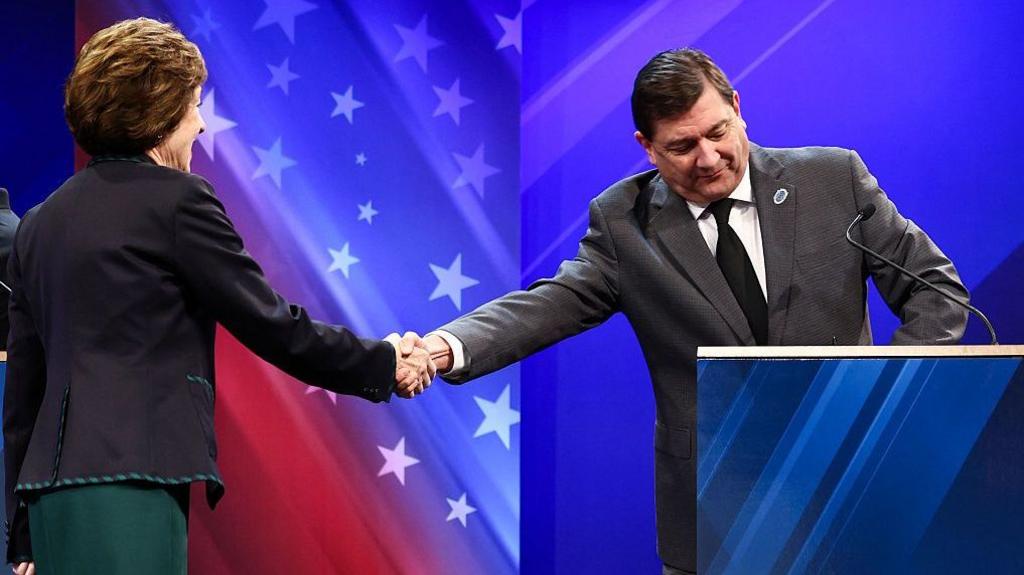
Over the past four weeks, Senate candidates from both parties have taken to televised debates that have ranged from policy‑heavy exchanges to rancorous personal jabs. These staged confrontations have produced a surprisingly clear signals about the direction of the race.
1. Republicans are not all Trump‑clinging
The trend of Republicans pinning their campaign heavy on Trump was a familiar sight in 2020, but the 2026 field now includes a significant number of candidates who explicitly distance themselves from the former president. Senator Susan Collins, the only U.S. senator to break with Trump on 137 votes in the last Congress, used a recent debate to underscore her policy differences, citing her alignment with President Biden on 91% of votes. In Maine, Collins faces a close fight against Democrat Troy Jackson, while in Iowa congresswoman Ashley Hinson has raised her own line, breaking with Trump on certain policy points yet retaining overall loyalty to his brand.
2. Personal attacks are everywhere
Another striking feature of the latest debates is the rapid escalation of personal attacks. In Michigan’s bruised Senate race, Democrat Abdul El‑Sayed fired back against Republican Mike Rogers with a rhetorical challenge about a possible “watchlist,” to which El‑Sayed responded with blunt, “I’m a sock puppet for the Trump administration.” Over in Georgia, Senator Jon Ossoff labelled Representative Mike Collins a “bigot” who has “hired half the Third Reich,” while Collins accused Ossoff of spreading “craziness.” These exchanges illustrate how the stakes of a seemingly unliked election can make topics of identity, religion and past political alliances ammunition.
3. Candidates are skipping debate stages
A third trend that could reshape the campaign terrain is a rise in candidates opting out of debates. 21 of the 35 already scheduled Senate races have no debate at all, according in part to an ABC analysis. The Texas battle between state representative James Talarico and former attorney–general Ken Paxton is a prime example. Paxton has declined to appear at any debate invitation, despite Tyler Paxton’s own notes that the former official will open a “venues of discussion.” This self‑imposed absence strips away the chance to challenge opponents directly and lets rivals seize the floor to further personal criticisms.
These dynamics suggest that while supply of policy debates may be dwindling, the emotional and ideological stakes could intensify the election, turning personal image, perceived nationalism, and media presence into decisive factors for voters. As the November vote approaches, the pattern of “not‑all‑republicans‑follow‑Trump,” “heavy‑personal‑attacks” and “debate‑vacations” will continue to puzzle analysts and shape the nation’s political narrative.