
In brief
The ongoing trade war between the US and China sees each side unwilling to negotiate first, as both Trump and Xi seek to preserve their public standing while managing serious economic pressures at home. With tariffs climbing to unprecedented levels, both nations hint at a willingness to talk, but neither is ready to show vulnerability.
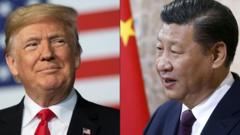
On Friday morning, the commerce ministry in China revealed that it was evaluating the potential for tariff negotiations with the United States, a development eagerly anticipated worldwide as extremely high tariffs - reaching as high as 245% on some Chinese exports to the US - continue to strangle trade between the two economies and heighten fears of an impending recession. "US officials have consistently expressed a willingness to negotiate regarding tariffs," stated a spokesperson during a press briefing. "China's stance remains unchanged. If we are to fight, we will do so until the last breath; if we are to converse, we remain open... However, if the US wishes to engage, it must demonstrate sincerity and be ready to amend its erroneous practices and repeal unilateral tariffs."This revelation followed a report from a Weibo account, associated with Chinese state media, claiming the US was eager to initiate discussions, alongside previous comments from Trump hinting that dialogue was in progress – a claim that Beijing refuted. "China has no necessity to engage with the United States," stated Yuyuantantian, the Weibo handler affiliated with China Central Television (CCTV), in a Thursday post. "From a negotiation standpoint, the United States must be the more anxious party at this moment." Such statements reflect a cycle of claims and counterclaims from both nations, as neither publicly expresses a readiness to begin discussions.The situation is likened to a game of chicken between Trump and Chinese President Xi Jinping, who are both keen on preserving their images while aiming for a de-escalation of hostilities amid the ongoing trade dispute. "I expect such fluctuations, as both Washington and Beijing wish to avoid appearing as the side that concedes," noted Ja Ian Chong, an assistant professor of political science at the National University of Singapore. "Yet a de-escalation would equally benefit both parties, suggesting a shared motivation to negotiate." Wen-Ti Sung, from the Australian Centre on China in the World, articulated it differently: "It's akin to two racing cars barreling toward each other; the moment one swerves, that party will be perceived as the weaker one. At this juncture, neither party is willing to appear weak." The leader who first admits to engaging in tariff discussions risks appearing vulnerable in negotiations, according to Mr. Sung. "The party that appears desperate loses negotiating power. Thus, both sides aim to frame the other as the more anxious." This peculiar standoff denotes a situation where both parties seek a resolution but remain cautious to avoid being perceived as the initiator, leading to a state of "constructive ambiguity" where language is employed to obscure the reality of the negotiations.Experts believe one possible retrieval from this 'game of chicken' could involve a third-party mediation, offering both nations a way out. Alternatively, a broader interpretation of what constitutes ‘the other side has reached out’ might enable negotiations to commence without either side appearing the first to budge. In Trump and Xi's scenario, starting negotiations would allow both leaders to assert a semblance of victory to their respective domestic audiences.The optics in this context are crucial as both leaders strive to showcase an accomplishment for their home bases. Trump, it is suggested, wishes to present that he has forced China into compliance, whereas Xi seeks to exemplify that his leadership has compelled Trump to adopt a more reasonable approach towards trade matters. Amid looming tariffs, Trump struggles to allay recession fears within the US as the economy shrank in the first quarter, while Xi must pacify worries amongst the Chinese populace regarding economic retaliation and post-COVID recovery complications.Neither leader is under the impression that their side will emerge unscathed from this trade war anymore. Observers note that Trump acknowledges he cannot attain all his desired objectives and seeks terms that allow him to claim some level of victory domestically despite considerably lowered ambitions. At present, Xi finds himself navigating a complicated scenario where he must simultaneously manage Chinese negotiations while projecting an image of resilience in the face of Western pressure.As it stands, the US has not refuted China's affirmations regarding attempts to engage in talks. Both sides acknowledging each other's claims indicates some form of interaction is taking place, according to Mr. Chong. While there is a chance for accommodation, the necessary conditions to stabilize US-China relations, which were tenuous even before the trade war, seem far from realization. Observers remain skeptical; according to Chong, the ongoing posturing suggests neither party is ready to genuinely seek an exit. Until then, this deadlock will persist as both parties wait to see who will yield first.


