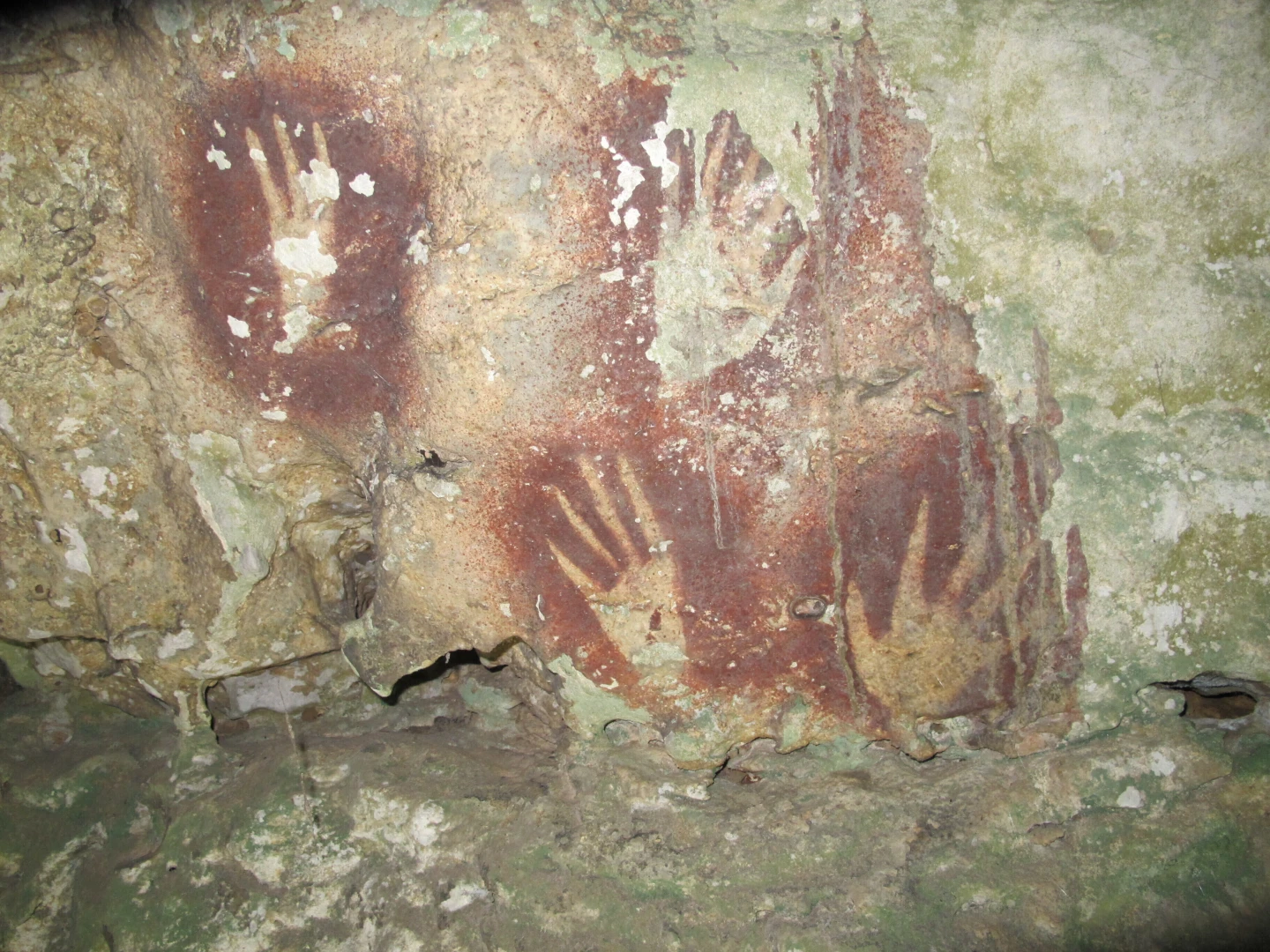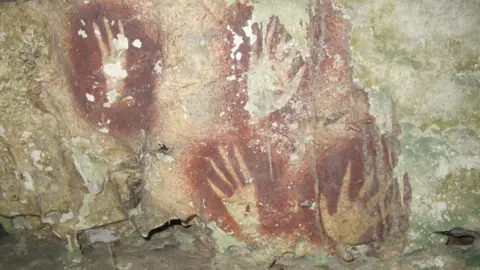
A stencilled outline of a hand found on the Indonesian island of Sulawesi is the world's oldest known cave painting, researchers say. It shows a red outline of a hand whose fingers were reworked, creating a claw-like motif that signifies an early advance in symbolic imagination. This painting has been dated to at least 67,800 years ago – approximately 1,100 years earlier than the prior record, a contested hand stencil in Spain. The discovery strengthens the argument that Homo sapiens reached the broader Australia–New Guinea landmass, known as Sahul, around 15,000 years earlier than many researchers previously contended.
The past decade has seen multiple discoveries on Sulawesi, suggesting that art and abstract thinking in humans emerged well before the Ice Age in Europe. Cave art is regarded as a crucial marker of human capability for abstract thought, characterized by the ability to represent and narrate experiences in ways unique to our species. Professor Adam Brumm of Griffith University, who co-led the project, mentioned that this finding adds to the perspective that creativity was inherent to Homo sapiens long before our recorded history began.
Unlike the simple handprints of our Neanderthal cousins, the Sulawesi stencil had elements of innovation—indicative of advanced cognitive abilities. This painting was part of a series of significant discoveries in Sulawesi that pushed back the timeline for artistic expression further than was once thought feasible.
The recent research also highlights a shift in understanding human migration to Sahul and challenges the long-held narrative of a sudden European 'big bang' of creativity. The findings propose that populations from Sulawesi were likely part of a broader migratory wave that shaped ancient artistic traditions across the region, further intertwined with the early development of human discourse and identity.
The past decade has seen multiple discoveries on Sulawesi, suggesting that art and abstract thinking in humans emerged well before the Ice Age in Europe. Cave art is regarded as a crucial marker of human capability for abstract thought, characterized by the ability to represent and narrate experiences in ways unique to our species. Professor Adam Brumm of Griffith University, who co-led the project, mentioned that this finding adds to the perspective that creativity was inherent to Homo sapiens long before our recorded history began.
Unlike the simple handprints of our Neanderthal cousins, the Sulawesi stencil had elements of innovation—indicative of advanced cognitive abilities. This painting was part of a series of significant discoveries in Sulawesi that pushed back the timeline for artistic expression further than was once thought feasible.
The recent research also highlights a shift in understanding human migration to Sahul and challenges the long-held narrative of a sudden European 'big bang' of creativity. The findings propose that populations from Sulawesi were likely part of a broader migratory wave that shaped ancient artistic traditions across the region, further intertwined with the early development of human discourse and identity.