In brief
The country's future hinges on unity, as Sharaa stresses disarmament while facing criticism for the conference's exclusion of key groups.
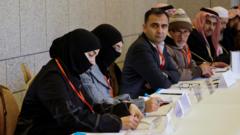
Syria’s interim president, Ahmed al-Sharaa, has heralded a "historic" national dialogue conference, positioning it as a critical moment for the nation to rebuild following the recent overthrow of Bashar al-Assad. Speaking at the event in Damascus, Sharaa emphasized the necessity for armed factions to integrate into the military, declaring that the state must retain a monopoly on weaponry, with "strength lies in its unity." The conference has attracted 600 delegates tasked with formulating recommendations on a variety of issues, including transitional justice, economic recovery, and drafting a new constitution. Nevertheless, the process has met with skepticism; the Kurdish-led militia alliance and the autonomous administration, which hold sway over northeastern Syria, were notably absent from the proceedings.The Assad family's dominant rule spanned over five decades, culminating in Bashar ascending to the presidency in 2000. After ruthlessly suppressing a pro-democracy protest in 2011, the civil war erupted, leading to the death of over 600,000 individuals and displacing 12 million. Following a swift rebel offensive led by Sharaa's Islamist faction Hayat Tahrir al-Sham (HTS) in December, Bashar fled to Russia, enabling Sharaa's rise to interim leadership amid a backdrop of significant political change.Sharaa affirmed the urgency of this transitional period, stating, "Syria liberated itself on its own, and it suits it to build itself on its own." In his view, the current atmosphere represents an exceptional chance that must be harnessed effectively for the betterment of the Syrian population.To stimulate discussions, the organizing committee emphasized the establishment of six working groups that aim to tackle the intricacies of transitional justice, constitutional amendments, state revitalization, personal freedoms, civil society roles, and future economic strategies. While non-binding recommendations will emerge from these discussions, they will provide crucial insights for the government set to begin its term on Saturday.In reiterating the need for a transitional justice mechanism, Sharaa committed to establishing a body to "restore people's rights" and to hold accountable those responsible for wartime atrocities. He urged non-state militias to disarm, positing that the unity and control of arms by the state is imperative.Despite control over major urban areas, significant territories remain governed by various armed groups, notably the Kurdish-led Syrian Democratic Forces (SDF), which manages the northeast portion of the country. Negotiations regarding the integration of SDF forces into the new Syrian military have unfolded in recent weeks, albeit with limited success thus far.The organizing body of the conference justified the exclusion of the SDF and the Autonomous Administration of North and East Syria (AANES) by stating that the SDF had not yet agreed to participate in the new government structure. However, SDF spokesperson Farhad Shami critiqued the absence as reflective of the conference's failure to genuinely engage with broad sections of Syrian society, asserting that these events cater more to international observers rather than to the realities of Syrian individuals.Several political groups, including 35 parties from the AANES, denounced the perceived tokenism regarding Kurdish representation and called for more genuine and inclusive dialogue to resolve ongoing national challenges. Moutasem Sioufi from the independent civil society organization The Day After stressed the necessity to involve all factions in dialogue to help guarantee Syria’s stability.The conference’s outcome is likely to garner global scrutiny, with international stakeholders urging an inclusive political agenda reflective of Syria's diverse populace. The civil war context has seen sanctions imposed by the US, UK, and EU against Assad's regime, now partially lifted to pave the way for humanitarian efforts, contingent upon the new leadership's commitment to democracy and minority rights. Amid these discussions, Syrian Foreign Minister Asaad al-Shibani condemned remaining sanctions, claiming they represent an illegitimate coercive force against the Syrian population while focusing on external legitimacy over internal reconciliation.