
In brief
A decade of pro-democracy protests in Hong Kong has given way to a landscape dominated by Beijing's control, yet memories of resistance persist among residents and exiles. With significant changes in political freedom and identity, individuals reflect on their city’s past, the impact of the oppressive national security law, and the importance of preserving their collective history.
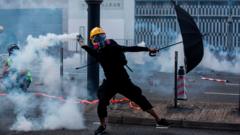
As Kenneth navigates through Hong Kong’s once vibrant and defiant Victoria Park, he reminisces about a bygone era when the city echoed with the voices of pro-democracy activists. The park, a former hub for resistance and remembrance, has now fallen silent as political expressions are met with confinement and surveillance. Kenneth recalls his childhood—buying calligraphy posters and participating in vigils for Tiananmen Square. But now, he feels the identity of Hong Kong fading away, smothered by Beijing’s extended authority.The facade of life in Hong Kong still appears lively, with bustling streets and familiar sights, yet subtle signs of change loom. As the language of the city shifts towards Mandarin, the essence of its cultural diversity feels threatened. Over the past decade, a significant wave of protests has swept the city, ignited in 2014 by demands for democratic freedoms, culminating in the heightened tensions of 2019 amidst the proposed extradition laws.China’s response, a stringent national security law, has led to the incarceration of many activists, including notable figures like Benny Tai and Joshua Wong. Their detainment symbolizes the chilling effect of the authorities' crackdown on dissent—an effort that has irreversibly altered Hong Kong’s landscape. Chan Kin-man, a co-founder of the initial Occupy Central movement, expresses his heartbreak from afar, having relocated to Taiwan after serving time for his role in the struggle. He reflects on the seeming impossibility for change that hangs over the city now, marking a stark contrast to the hope he once felt.This pervasive sense of loss is echoed among those who have chosen to leave Hong Kong. Kasumi Law, now living in the UK, recalls the alarming realization that her city was changing beneath her feet. Motivated by concern for her daughter's future amid escalating oppression, Kasumi opted to build a new life abroad—a decision shadowed by nostalgia and heartache. Even as her family adapts to their new environment, she remains determined to maintain her Hongkonger identity and heritage.Both Kenneth and Kasumi embody the resilience of a community that refuses to accept the narrative that Hong Kong is no longer what it once was. Though memories of protests and freedoms slip further into the past, the tenacity to remember and honor those experiences shines through. Kenneth’s clandestine collection of protest memorabilia symbolizes hope and defiance in a city that feels increasingly like a forgotten chapter.Despite the present’s oppressive climate, the flames of recollection burn brightly in the hearts of many. They continue to champion the memory of a freer, diverse Hong Kong, challenging the very notion of forgetting. "Forgetting the past is a form of betrayal," Kenneth asserts, as the intricate fabric of their culture and collective history remains etched in the amidst a struggle for identity and voice.

