
In brief
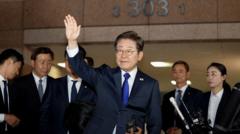
President Lee Jae-myung, despite a significant electoral mandate, steps into office during a critical time. With immediate challenges posed by Donald Trump's trade tariffs and security negotiations, Lee's leadership will be tested as he seeks to unify South Korea and bolster its democracy in the face of potential economic upheaval.
As South Korea's newly inaugurated president, Lee Jae-myung, readies himself for office, he faces pressing challenges that can alter the nation's trajectory. Winning almost 50% of the vote, Lee emerged as a beacon of hope for a public weary from political strife under his predecessor, Yoon Suk Yeol, who was impeached following attempts to impose martial law. However, Lee's immediate duties are compounded by looming crises that bear the unmistakable hallmark of Donald Trump's policies.Lee's ascent to power comes at a tumultuous time, with the country facing the possible repercussions of high tariffs on Korean imports that Trump instituted earlier in the year. South Koreans are alarmed that these tariffs, which follow previous hits to key industries like steel and automotive, could lead to a deeper economic contraction. A trusted advisor to Lee’s Democratic Party expressed concern that failure to navigate this trade landscape could trigger a full-blown economic crisis just as South Korea’s economy, already in decline, is beginning to recover from past turmoil.Moreover, Lee's administration, which traditionally favors improved relations with China, must also confront the intertwining issues of trade and security in the negotiations with the Biden administration. Trump has made clear that he views these areas as linked; he has publicly indicated that South Korea needs to contribute more financially to its own defense while being part of the US-led effort to counterbalance China's influence in the region.Former US diplomat Evans Revere warns of an escalating crisis, given Trump's past inclination to leverage South Korea's reliance on US military support for better trade deals. Trump's recent posts indicate a willingness to intertwine military presence discussions with economic negotiations, and this could place South Korea in a precarious position.As regional tensions rise, particularly with North Korea's nuclear ambitions and the geopolitical chess game involving China, Lee's administration is faced with defining its response. North Korea, under Kim Jong Un, appears to have augmented its position compared to previous years, making it critical for South Korea to engage proactively with both the US and its northern neighbors.Lee's strategy must involve not only safeguarding South Korea's economic interests but also ensuring its security amidst increased military threats. While Lee hopes to maintain autonomy in dealing with China and avoid entanglement in the US-China rivalry, the pressure from Trump and his approach to negotiations complicates this goal.In a bid to solidify ties with the US, Lee may emphasize South Korea's naval capabilities, leveraging its position as a leading shipbuilding nation to showcase its value as a strategic partner to Washington. This relationship will be pivotal moving forward, as South Korea works to establish its presence amid evolving regional dynamics.As the new president embarks on this high-stakes journey, he must quickly build a cohesive strategy to address both domestic discontent and international pressures. The delicate balance of navigating Trump’s potential demands while prioritizing South Korea's sovereignty and regional stability will set the tone for Lee's administration—and the future of South Korea itself.
