In brief
In a controversial court ruling, Tunisia has sentenced numerous opposition leaders and supporters to prison terms ranging from four to 45 years for allegedly attempting to depose President Kais Saied. The court's actions are viewed as politically motivated, following a widespread crackdown on dissent since Saied’s tenure began in 2021. Human rights groups have criticized the trial, highlighting the usage of the judicial system to stifle political opposition.
A Tunisian court has handed jail terms to dozens of opposition leaders, lawyers, and businessmen accused of attempting to overthrow the nation's president.
Forty people, including opposition leader Jawahar Ben Mbarek, received sentences ranging from four to 45 years over the alleged conspiracy to oust President Kais Saied.
Twenty of those charged have fled abroad and were sentenced in absentia, while others have been held in detention since 2023.
Human rights groups have criticized the trial as politically motivated, characterizing the prosecutions as an escalation of Saied's crackdown on dissent since he suspended Tunisia's parliament in 2021 and began ruling by decree.
Tunisian authorities argue that the defendants, including former head of intelligence Kamel Guizani, attempted to destabilize the country and topple Saied.
Ben Mbarek, along with party leaders Issam Chebbi and Ghazi Chaouachi, received jail terms of 20 years. All three have been detained since the 2023 crackdown.
The maximum sentence, 45 years, was given to businessman Kamel Ltaif, while opposition politician Khyam Turki received a 35-year term.
Ben Mbarek has been on hunger strike for over a month and is reported to be in critical condition.
Among those sentenced in absentia were politician and feminist Bochra Belhaj Hmida, as well as French philosopher Bernard-Henri Levy.
The final sentences were issued by an appeals court following an initial ruling in April where Saied labeled the opposition leaders as 'terrorists.'
A lawyer for the defendants described the trial as a 'farce,' alleging its clear intent to eliminate political opponents.
Human rights groups, including Amnesty International, decried the sentences as 'unjust' and indicative of a deteriorating justice system in Tunisia.
UN High Commissioner for Human Rights Volker Turk expressed serious concerns regarding the political motivations behind the trial and urged the Tunisian government to halt its use of national security legislation to suppress dissent.
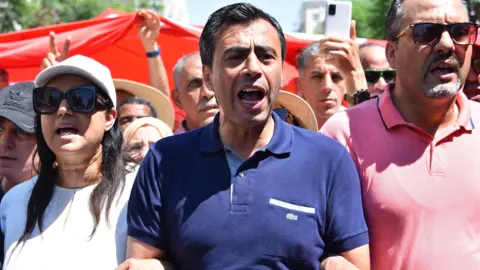
Recently, protests erupted in the capital Tunis, with thousands accusing Saied of consolidating power amid a backdrop of democratic regression in the nation once hailed as a beacon of the Arab Spring.