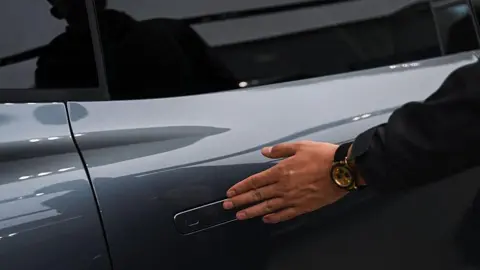
China has banned hidden door handles on electric vehicles (EVs), making it the first country to stop the use of the controversial designs that were made popular by multi-billionaire Elon Musk's Tesla. This decision comes in light of increased scrutiny on EVs from safety watchdogs due to several serious incidents, including fatal crashes involving Xiaomi EVs, where power failures were suspected to have prevented doors from being opened.
Under the new regulations, only vehicles equipped with mechanical release options on both the inside and outside of their doors will be permitted for sale. These changes will take effect on January 1, 2027.
According to state media, the Ministry of Industry and Information Technology mandates that all passenger doors (except the boot) must feature a recessed space of at least 6 cm by 2 cm by 2.5 cm for easy handle access. Additionally, there are new interior signage requirements to assist passengers in operating the door mechanisms.
Vehicles already in the approval pipeline will have a grace period of two years to comply with the new regulations.
The decision particularly impacts China's growing new energy vehicle (NEV) sector, where hidden handles are prevalent; they are found in about 60% of top-selling NEV models. While the new rules primarily affect models sold domestically, they are expected to ripple through the global car market, as China's automotive influence is significant worldwide.
Concerns about Tesla's handle designs are not isolated to China; they are currently being investigated by US safety regulators following reports of malfunctioning handles trapping children inside vehicles. The US National Highway Traffic Safety Administration (NHTSA) has received multiple complaints regarding Tesla's 2021 Model Y door mechanisms. Reports indicate that some owners had to break their windows to exit the vehicle during lockout situations.
Under the new regulations, only vehicles equipped with mechanical release options on both the inside and outside of their doors will be permitted for sale. These changes will take effect on January 1, 2027.
According to state media, the Ministry of Industry and Information Technology mandates that all passenger doors (except the boot) must feature a recessed space of at least 6 cm by 2 cm by 2.5 cm for easy handle access. Additionally, there are new interior signage requirements to assist passengers in operating the door mechanisms.
Vehicles already in the approval pipeline will have a grace period of two years to comply with the new regulations.
The decision particularly impacts China's growing new energy vehicle (NEV) sector, where hidden handles are prevalent; they are found in about 60% of top-selling NEV models. While the new rules primarily affect models sold domestically, they are expected to ripple through the global car market, as China's automotive influence is significant worldwide.
Concerns about Tesla's handle designs are not isolated to China; they are currently being investigated by US safety regulators following reports of malfunctioning handles trapping children inside vehicles. The US National Highway Traffic Safety Administration (NHTSA) has received multiple complaints regarding Tesla's 2021 Model Y door mechanisms. Reports indicate that some owners had to break their windows to exit the vehicle during lockout situations.