
Belfast Burning Homes: One Man’s Despair Amid Night of Violent Fires
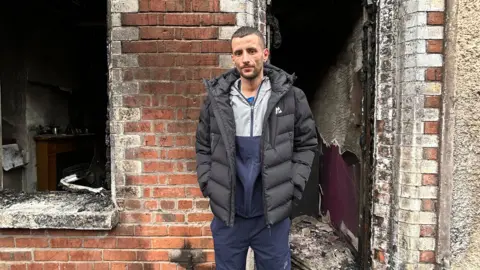
For Jamie Corrie, whose brown‑haired, black‑coat figure sits beside the charred foundations on Lendrick Street, the devastation was personal. He watched the flames lift and the smoke roll over his home that he had called home for 13 years. “I told them before they were lighting the car, I said ‘this is my property.’ Standing there watching my house get burnt… that’s a feeling I’ll never get over,” he says, his voice trembling as he recounts the moment he realized the fire had already engulfed the building before firefighters arrived.
The night of the violence left multiple houses ablaze across east and north Belfast. After a knife attack on Monday night, anger flared and “foreign nationals” parked cars on the streets were torched. The fire spread to adjacent properties and forced families, some with infants, to flee with little more than their clothing. The community’s sense of safety has been shattered, with reports of wounded men, stolen vehicles and widespread property damage.
In the aftermath, voices have surged. A Ukrainian‐Irish family on the same street fought to escape the smoke. Yura, 19, recalled, “My neighbour’s house was set on fire. My front door caught the fire a bit. It had to be kicked out to stop the fire because it was about to go in the house.” She and her friends fled to the beds of residents nearby, grateful for the safety offered by a neighbour who stayed close.
Healthcare workers have also voiced concern. Senior nurse Biji Jose of the Northern Ireland Indian Nurses Forum, who has worked here for 23 years, spoke of a “really worried” atmosphere among junior colleagues. “People sometimes think about we are here to take their job. No, it is not the way,” she says, underlining how critical healthcare staff remain to the public.
While the unrest continues, several community leaders, including Pastor Jack McKee, stand as beacons of support for those whose homes were targeted. He says he will do his best to help families that were “being put out just because they’re black.” Rev. Brian Anderson recalls bitter memories of the past when one’s colour could lead to a home burning, stating, “It took me back to an experience of my childhood.” His testimony underlines the long‑lasting scars of sectarian division.
In the broader context, a 30‑year‑old Sudanese native, Hadi Alodid, was charged with attempted murder after the knife attack, while Stephen Ogilvie’s family advocates for “peaceful protest as the only way forward.” The situation has prompted calls for more measured civil action, as authorities close public transport and businesses out of caution.
During this tense climate, some residents have decided to move away. An unnamed man from India, after being displaced by the violence, states he and his family were “leaving right now,” describing the night as a war zone. Their departure underscores the intense fear gripping parts of the city.
Police and community leaders are working to quell the unrest, emphasizing that further violence would only deepen the divisions. Belfast’s residents face an uncertain future, with families realizing the physical and emotional toll of a week in which their very homes were turned to ash. The aftermath presents both a heartbreaking human story and an urgent call for peace and stability across Northern Ireland’s troubled cityscape.