
In brief
With the addition of new member states, the evolving Brics alliance proves beneficial for India, enhancing its diplomatic leverage and aligning with its foreign policy goals even amidst growing concerns of anti-West sentiment within the group.
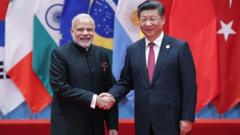
The article text:Brics is emerging as a significant player in global geopolitics, and India's engagement with the group is proving to be advantageous. Historically, critics in the West have viewed Brics as merely a collection of developing nations lacking influence. However, the recent annual summit in Russia marked a turning point, seeing leaders from 36 countries, including representatives from Egypt, Ethiopia, Iran, and the UAE, indicating Brics' growing clout.For India, a member perceived as leaning towards Western orientations, the expansion of Brics provides a multifaceted opportunity. India has established strong trade and security relationships with many of the newly inducted members, particularly Egypt and the UAE. Furthermore, India's longstanding partnership with Ethiopia enhances its regional standing in Africa.The Brics framework allows India to reaffirm its connections with Russia, counteracting Western attempts to isolate it. Simultaneously, collaborating with China within Brics presents India with a diplomatic avenue to slowly ease existing tensions, particularly against the backdrop of recent border agreements.Maintaining a foreign policy of strategic autonomy, India seeks to balance its relationships across a spectrum of geopolitical players. Its involvement in Brics complements its ties with Western nations through initiatives like the Indo-Pacific Quad while embracing a diverse range of partnerships globally.Brics' articulated goals resonate with Indian priorities: enhancing engagement with the Global South, bolstering multilateralism, advocating for reforms in the United Nations, and questioning the existing sanctions regime imposed by the West. Nonetheless, the rapid expansion of Brics could raise concerns over the potential for an anti-Western agenda, especially with the inclusion of contentious members like Iran and the possible induction of Belarus and Cuba.Despite these concerns, it is crucial to recognize that the membership expansion does not uniformly translate into an anti-West bloc. New members, apart from Iran, maintain significant ties with Western nations, making outright opposition to Western policies unlikely.Although discussions on creating alternatives to US dollar dependency and evading Western sanctions have arisen, significant challenges remain within Brics. Cohesion and consensus are hard to achieve, especially with diverse and often conflicting interests among new members, such as the strained relations between Iran, Egypt, and the UAE.India's relationship with China continues to pose challenges, underpinning the complexity of navigating internal relationships within Brics. Despite the recent border agreement between China and India signaling an opportunity for collaboration, the underlying geopolitical competition remains intense.In essence, Brics emerges as a strategic platform for India, allowing it to engage with ideal partners while reinforcing its own principles of multi-polarity and cooperation. Future collaborations in less controversial areas like climate change and education can foster a harmonious existence between Brics and Western nations, reinforcing India's preference for balanced relations. Ultimately, the expansion of Brics provides an important avenue for India to reaffirm its global presence and chart a course that seeks stability rather than adversarial posturing.
