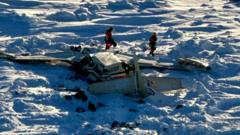
Crews continue their search for victims of a devastating plane crash in Alaska, where all ten individuals aboard the ill-fated Cessna Grand Caravan have been confirmed dead. The plane, operated by regional carrier Bering Air, was en route from Unalakleet to Nome when it abruptly vanished from radar on Thursday afternoon.
Jennifer Homendy, the chair of the National Transportation Safety Board (NTSB), emphasized that the investigation is still in its preliminary phase, making it difficult to ascertain the causes behind the accident. Among those confirmed dead are Rhone Baumgartner and Kameron Hartvigson, both employees of the Alaska Native Tribal Health Consortium who were traveling to conduct maintenance work on a water facility.
During a news conference in Anchorage, Alaska’s largest city, Ms. Homendy expressed her heartfelt condolences to the families affected by this tragedy. "Recovery efforts are still under way, with the priority being victim recovery," she stated, highlighting complications from deteriorating weather conditions. The wreckage was reported to be located on a moving ice floe, traversing at about five miles per day, which adds urgency to the recovery operation.
The US Coast Guard swiftly responded to what was described as an "overdue" aircraft shortly after 16:00 local time on Thursday. Reports indicated that the pilot communicated with air traffic control about entering a holding pattern prior to losing altitude and speed rapidly, ultimately leading to the crash.
Senator Lisa Murkowski and Governor Mike Dunleavy shared condolences, reflecting on the close-knit nature of the Alaskan community and the heavy toll of such tragedies. Unalakleet and Nome are situated approximately 150 miles apart across the expanse of Norton Sound in the Bering Sea, connecting their communities closely amid this sorrowful event.
The investigation is being supported by specialists based in Washington, D.C., as the state of Alaska continues to mourn the loss of lives in this tragic aviation incident.