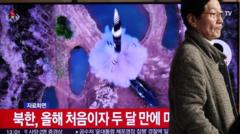
During a meeting earlier on Monday, Blinken underscored the strong alliance between the US and South Korea, referring to it as the "cornerstone of peace and stability on the Korean peninsula." In response to North Korea's missile activity, South Korea's military indicated that they had heightened surveillance capacities and were working closely with both the United States and Japan to assess and share information regarding this latest launch.
The missile test also comes amid ongoing political turmoil in South Korea, where suspended President Yoon Suk Yeol is entangled in impeachment proceedings and faces possible arrest after being stripped of his presidential powers. Just last year, Yoon's controversial attempt to declare martial law was met with strong backlash, both locally and from the North, which denounced his actions as dictatorial.
Historically, North Korea's missile launches have often been timed to coincide with international or regional events. The last notable test occurred in November, shortly before the US presidential election, during which North Korea launched at least seven short-range ballistic missiles. This recent launch could complicate diplomatic efforts in the region and heightens tensions as the international community continues to grapple with the unpredictable actions of Kim Jong Un's regime.
Experts and analysts are now watching closely for further developments, especially in light of previous warnings stemming from high-profile military exercises conducted by the US with South Korea and Japan, which North Korea has condemned as provocative. The unfolding situation remains fluid as Moscow's war efforts may have implications for Pyongyang's military strategy moving forward.
The missile test also comes amid ongoing political turmoil in South Korea, where suspended President Yoon Suk Yeol is entangled in impeachment proceedings and faces possible arrest after being stripped of his presidential powers. Just last year, Yoon's controversial attempt to declare martial law was met with strong backlash, both locally and from the North, which denounced his actions as dictatorial.
Historically, North Korea's missile launches have often been timed to coincide with international or regional events. The last notable test occurred in November, shortly before the US presidential election, during which North Korea launched at least seven short-range ballistic missiles. This recent launch could complicate diplomatic efforts in the region and heightens tensions as the international community continues to grapple with the unpredictable actions of Kim Jong Un's regime.
Experts and analysts are now watching closely for further developments, especially in light of previous warnings stemming from high-profile military exercises conducted by the US with South Korea and Japan, which North Korea has condemned as provocative. The unfolding situation remains fluid as Moscow's war efforts may have implications for Pyongyang's military strategy moving forward.